CREW
“No captain can succeed without a crew who rows together.” — Unknown

College rowing holds the distinction of being the oldest intercollegiate sport in the United States, with roots reaching back to the mid-19th century. It began in earnest in 1843 when Yale University founded the first collegiate rowing club, followed closely by Harvard. In 1852, these two schools competed in what became the first intercollegiate athletic event in U.S. history: a rowing race on Lake Winnipesaukee in New Hampshire. Organized as a promotional stunt by a railroad company, the race marked the beginning of the historic Harvard–Yale Regatta, a rivalry that continues to this day and stands as one of the most prestigious traditions in college athletics.
As the sport grew in popularity, other institutions followed suit. By the late 1800s, schools like Princeton, Cornell, Columbia, and Penn had established programs, forming a core of elite rowing competition in the Northeast. Cornell, under coach Charles Courtney, emerged as a powerhouse during this period, dominating national regattas with fast, technically sound crews. In 1895, the Intercollegiate Rowing Association (IRA) was founded by Cornell, Columbia, and Penn to host a national championship regatta, giving structure to a growing and increasingly competitive sport.
Throughout the 20th century, rowing remained a signature sport among Ivy League schools, known for its demanding physical rigor and its emphasis on teamwork, discipline, and tradition. At many universities, rowing became as much a cultural identity as an athletic pursuit, with early morning practices, storied boathouses, and deeply ingrained rivalries. During this era, schools like Harvard, Yale, and the University of Washington not only dominated collegiate rowing but also supplied the bulk of athletes for U.S. Olympic rowing teams, further elevating the sport’s prestige.
In the latter half of the century, rowing expanded beyond its Ivy League and East Coast roots, with strong programs developing on the West Coast and among non-Ivy schools. Women’s collegiate rowing grew significantly after Title IX legislation in 1972, leading to the inclusion of women's rowing in NCAA championships by 1997. Today, college rowing includes a broad network of programs across the country, both varsity and club-level, and remains one of the most enduring and respected sports in the collegiate world. With its rich blend of tradition, athleticism, and team spirit, collegiate rowing continues to honor its historic origins while evolving with the modern era.
Harvard’s Men’s Rowing
How Competitive Rowing Works
The Basics
Goal: Be the first boat to cross the finish line over a specific course, typically 2,000 meters for collegiate and Olympic-style races.
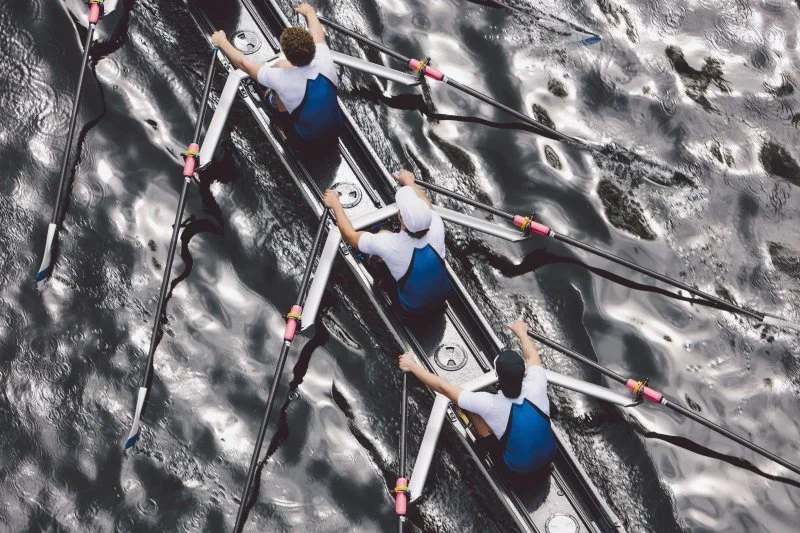
Team sizes: Boats can have 1, 2, 4, or 8 rowers, either with or without a coxswain (the person who steers and gives commands).
Two disciplines:
Sweep rowing: Each rower uses one oar. Seen in pairs (2+ or 2-), fours (4+ or 4-), and eights (8+).
Sculling: Each rower uses two oars. Seen in singles (1x), doubles (2x), and quads (4x).
Coxswain (Cox)
Found in many team boats (especially 8+).
Steers the boat, calls the race plan, motivates the crew, and ensures safety and alignment.
Race Format and Rules
Race Length
Standard race distance: 2,000 meters (Olympic/collegiate)
Head races (fall): Time trials over 3,000–6,000 meters
Sprint races (spring): Side-by-side racing over 2,000m
Lanes and Starting
Crews line up in parallel lanes.
A rolling or standing start depending on the race.
Aligners ensure boats start fairly.
At the command "Attention… Go!", all crews begin simultaneously.
Winning
First across the finish line wins (in sprint).
In head races, fastest time wins.
Fouls and Penalties
Boats must stay in their lanes (buoyed or virtual).
Interference can result in time penalties, warnings, or disqualification.
Officials use launches to follow and monitor races.
Rowing Season (U.S. Collegiate Model)
Fall Season (Sept–Nov)
Head races: Long-distance, time-trial format (3k–6k meters)
Notable races: Head of the Charles (Boston), Head of the Schuylkill (Philadelphia)
Winter (Dec–Feb)
Indoor training on rowing machines (ergometers)
Heavy focus on strength, endurance, and technique
Spring Season (Mar–June)
Sprint races: 2,000m side-by-side regattas
Championship races: Eastern Sprints, Ivy League Champs, IRA, NCAA, National Regattas
Regattas and Championships
Collegiate: IRA (men), NCAA (women), Eastern Sprints, Pac-12s, Big Ten Champs
International: Olympics, World Rowing Championships, Henley Royal Regatta (UK)
Club and Youth: Head of the Charles, USRowing Youth Nationals, Scholastic events
Strategy and Race Plan
Common Phases in a 2,000m Race:
Start (0–250m): Explosive high-rate strokes (40–45 spm) to gain advantage
Settle (250–750m): Settle to sustainable pace (~34–38 spm)
Middle (750–1500m): Maintain rhythm and build pressure
Sprint (1500–2000m): Rate increases again to finish strong (up to 40+ spm)
Weight Classes
Open/Heavyweight: No weight restriction
Lightweight:
Women: ~130 lbs (59 kg) average
Men: ~155 lbs (70.5 kg) average
Weight class matters most at college and international levels, particularly for fairness in smaller boats.
Competitive rowing boats—commonly called shells—have a long and storied history defined by craftsmanship, innovation, and performance. From the handcrafted wooden vessels of the 19th century to today's ultralight carbon-fiber machines, rowing shells have evolved in response to the needs of speed, stability, and symmetry on the water.

The origins of racing shells can be traced to ancient civilizations like Egypt, Greece, and Rome, where long, oared boats were used for war, trade, and transport. Modern competitive rowing, however, took shape in 18th-century England, where watermen on the Thames River began racing narrow boats for wagers. These early racing boats were wide and heavy by today’s standards, with fixed seats and little attention to hydrodynamic efficiency. As rowing gained popularity, particularly among university clubs like Oxford and Cambridge, builders began developing lighter, more streamlined hulls. A pivotal innovation came in the 1850s with the introduction of sliding seats, which allowed rowers to use their legs in the stroke, dramatically increasing power and speed.
In the United States, fine wooden shell construction reached its peak in the early 20th century. Legendary boatbuilder George Pocock, based in Seattle, brought craftsmanship and precision engineering to the sport, crafting cedar shells that were as beautiful as they were fast. Pocock’s boats—often made of western red cedar with ash frames and mahogany inlays—were varnished to a deep luster and carefully balanced by hand. His boats became the standard for many collegiate programs and Olympic crews, including the famous University of Washington team that won gold at the 1936 Berlin Olympics, as recounted in The Boys in the Boat.
-
Origins: The Birth of Collegiate Rowing (Mid-1800s)
Rowing as a competitive collegiate sport began in the mid-19th century, inspired by the long tradition of rowing at Oxford and Cambridge in England.
1843: Yale University founded the Yale Boat Club, the first collegiate rowing club in the U.S.
1852: The first intercollegiate sporting event in American history was a rowing race between Harvard and Yale on Lake Winnipesaukee in New Hampshire, organized by a Boston railroad company to attract tourists.
This marked the beginning of the Harvard–Yale Regatta, the oldest active college sporting rivalry in the United States. The race has been held almost every year since, typically on the Thames River in New London, Connecticut.
Expansion and Rivalries (Late 19th Century)
As rowing grew in popularity, other Ivy League schools formed teams:
Princeton (1870s)
Columbia (1870s)
Cornell (1873)
Penn (1872)
Brown (1857, revived later)
Dartmouth (founded its rowing program later in the 20th century)
In 1875, Harvard, Yale, and Princeton organized the Rowing Association of American Colleges, and the sport began to attract national attention.
Cornell became dominant in the late 1800s and early 1900s under legendary coach Charles Courtney.
The Intercollegiate Rowing Association (IRA) was established in 1895, with Ivy League schools participating alongside others like Navy and Wisconsin.
Ivy Rowing Culture: Prestige and Discipline
Ivy League rowing developed a distinct culture centered on:
Early morning practices on fog-covered rivers
Long-standing rivalries, especially Harvard–Yale and Princeton–Harvard–Yale (the “Big Three”)
Exclusive boat clubs and boathouses on scenic rivers
Heavy alumni involvement and tradition, with many rowers going on to Olympic success
Rowing is often considered the sport that best exemplifies the Ivy League ethos: elite, grueling, traditional, and team-oriented.
Olympic Glory and World Recognition
Ivy League programs have produced numerous Olympians:
Harvard, Yale, and Princeton rowers regularly contribute to the U.S. National Team.
At the 1924 and 1932 Olympics, Ivy athletes helped win gold for the U.S.
Many Ivy coaches (especially from Yale and Princeton) have gone on to coach national and Olympic crews.
Modern Era: Tradition Meets Evolution
Today, Ivy League rowing maintains its traditional character while adapting to modern sports:
The Eastern Sprints and IRA National Championships are major regattas.
Ivy schools participate in both heavyweight and lightweight crew, with the Ivy League also sponsoring a formal Ivy League Women’s Rowing Championship.
The Head of the Charles Regatta in Boston, co-founded by Harvard affiliates, is now the largest 2-day rowing event in the world, drawing global competition and thousands of spectators.
Notable Regattas and Events
Harvard–Yale Regatta – the oldest collegiate sporting event in America
Princeton–Harvard–Yale (HYP) Regatta
Ivy League Championships (especially for women)
Eastern Sprints (men’s rowing, includes all Ivy teams)
IRA National Championships
Head of the Charles Regatta (not Ivy-exclusive but heavily Ivy-influenced)
Legacy
Ivy League rowing has become not only a symbol of athletic excellence but also of academic and cultural prestige. It continues to draw dedicated student-athletes from around the world, and many Ivy League rowing alumni credit the sport for instilling lifelong values of resilience, teamwork, and leadership.